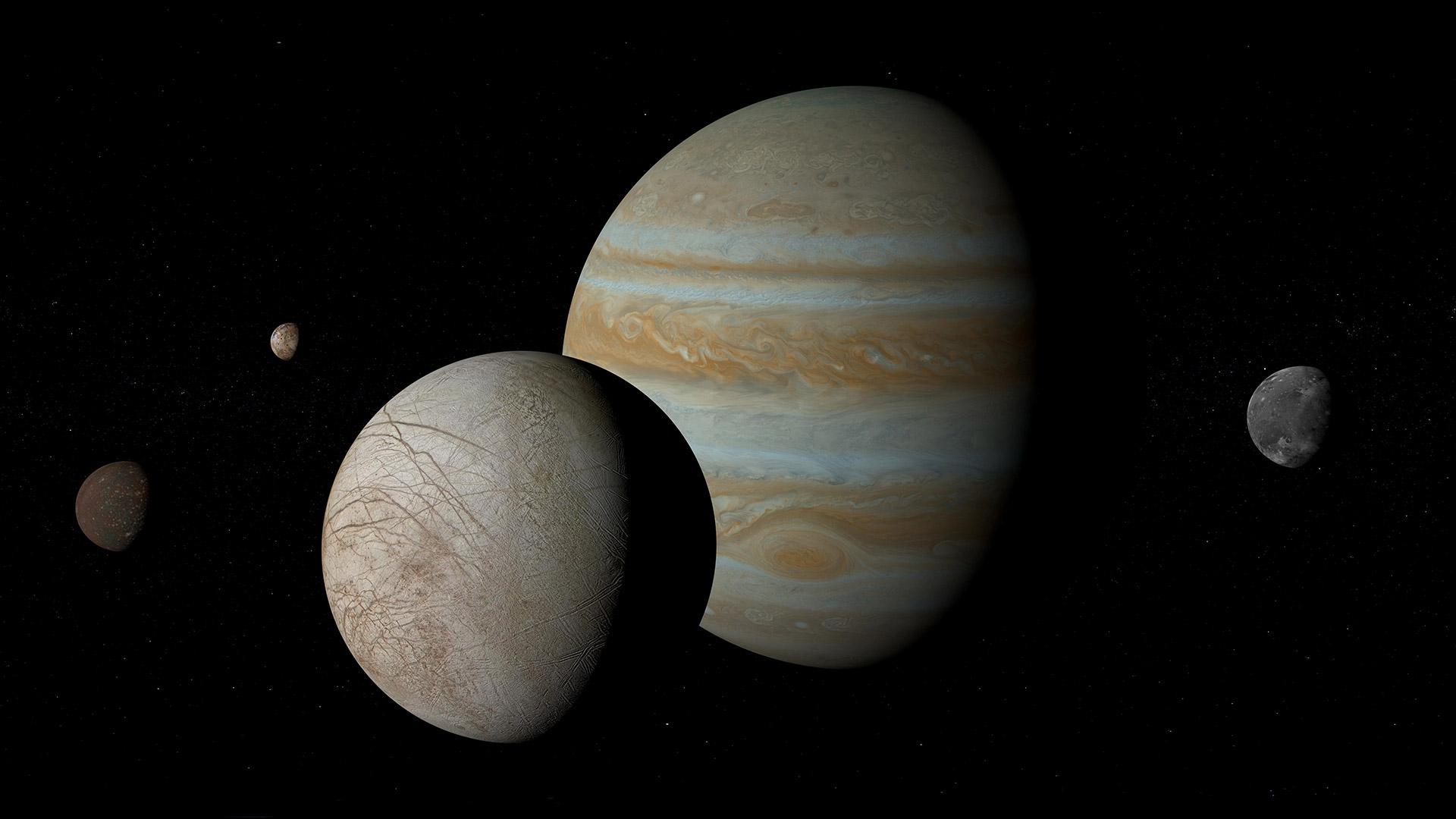
On January 7, 1610, Galileo was the first person to train a telescope on Jupiter—and what he saw surprised him. Strung in a line beside the planet were three tiny stars, one to the left of the planet and two to the right. But when he observed the formation the next night, he saw that now all three were on the same side of Jupiter. Over the following week, he watched as the tiny stars (now joined by a fourth) changed their position relative to the planet while remaining beside it. By January 15, he had it figured out: he was observing four moons orbiting Jupiter.
Jupiter and the Galilean moons
Today in History
More Desktop Wallpapers:
-
National Mushroom Day
-
Castelmezzano, Italy
-
Jerte Valley in bloom
-
Remembering Jimmy Carter
-
An enduring vision
-
Oktoberfest begins
-
Talk like a pirate—or walk the plank
-
African bush elephants in Namibia
-
Italy s submerged village
-
Land of the midnight sun
-
Amelia Earhart
-
Everglades National Park, Florida
-
Black bear cub emerging into spring
-
50 years of Earth Day
-
World Wildlife Day
-
Did they forget to fly south?
-
Walton Lighthouse, Santa Cruz, California
-
Gateway Arch in St. Louis, Missouri
-
Fallow deer, Bradgate Park, Leicestershire, England
-
A day to celebrate teachers
-
A wild and scenic scene
-
March of the flowers
-
Autumn equinox
-
A river runs through it
-
The town of Pienza in Tuscany, Italy
-
Dark skies over New Mexico
-
An unlikely friendship in the wild
-
A storied trail marks a century
-
Happy Diwali!
-
In the Garden of Europe
Bing Wallpaper Gallery