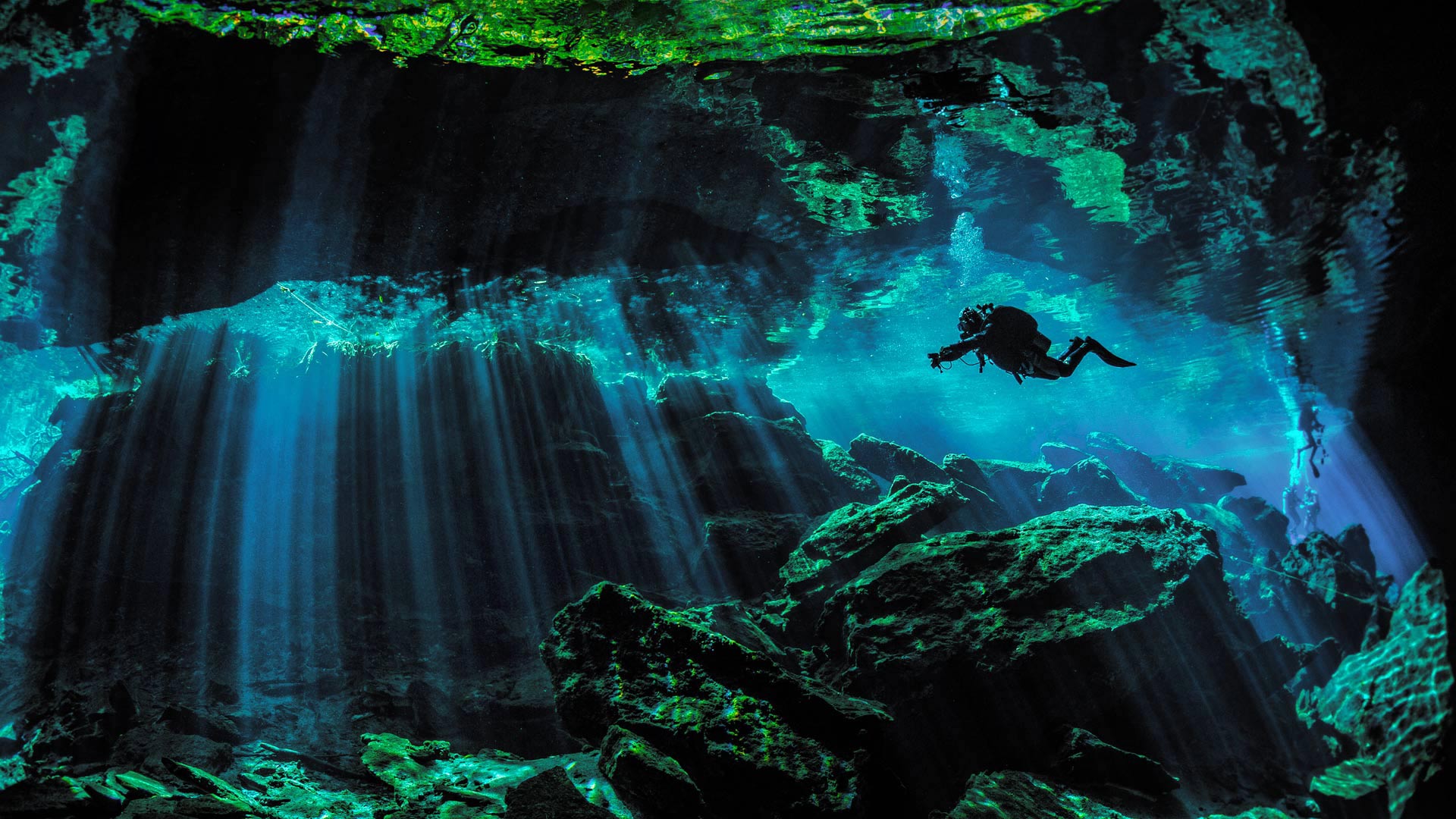
Like a giant block of Swiss cheese, Mexico"s Yucatán Peninsula is riddled with holes called cenotes. Cenotes form when subterranean limestone dissolves, allowing underground water to penetrate. The rock above may cave in, forming a sinkhole that reveals the cool, often crystal-clear water. Other cenotes may remain below the surface, hidden and often unexplored. Cenotes vary in size from very small to several dozen yards across, and recent discoveries have shown that some cenotes lead to a series of underground cave systems that can span several miles in length.

Cenote near Puerto Aventuras, Mexico
Today in History
More Desktop Wallpapers:
-
Chinese New Year
-
Winter solstice
-
Entoloma hochstetteri mushroom at Lake Mahinapua, New Zealand
-
St. Joseph North Pier Inner and Outer Lights, Michigan
-
Here there be dragons
-
Dunquin Pier, County Kerry, Ireland
-
The Grand Départ: Tour de France begins
-
Apples ready for harvest in Minnesota
-
Jane’s Carousel delights
-
Telašćica Nature Park, Dugi Otok, Croatia
-
A day for our oceans
-
Aqueduct, Arkadia Park, Poland
-
Mosque-Cathedral of Córdoba, Andalusia, Spain
-
Squirrel Appreciation Day
-
These laurels are hardy
-
Does this chameleon look a little insecure?
-
Cetacean Saturday
-
Saint Nicholas Day in Verbier, Switzerland
-
Horse Head Rock, New South Wales, Australia
-
SantaPark, Lapland, Finland
-
Everyone s watching the Perseids
-
Let the games (finally) begin!
-
Life carries on, rising from a ship s skeleton
-
Storseisundet Bridge, Norway
-
Earth seen from the International Space Station
-
World Childrens Day
-
Sailing on thick ice
-
It s Bermuda s big day
-
Pascua Florida Day
-
The Wave at Coyote Buttes
Bing Wallpaper Gallery